
Example video
How much do YouTube Shorts pay for 1,000 views?
- 36 sec
- 9:16 vertical
- AI script, voiceover & subtitles
- Made with StickReel
This is the question every new Shorts creator asks, and the honest answer is smaller than most expect. The video puts real numbers on it in 36 seconds: what you earn before monetization, what the two qualifying paths are, what the per-thousand rate looks like in practice, and why the figure moves around.
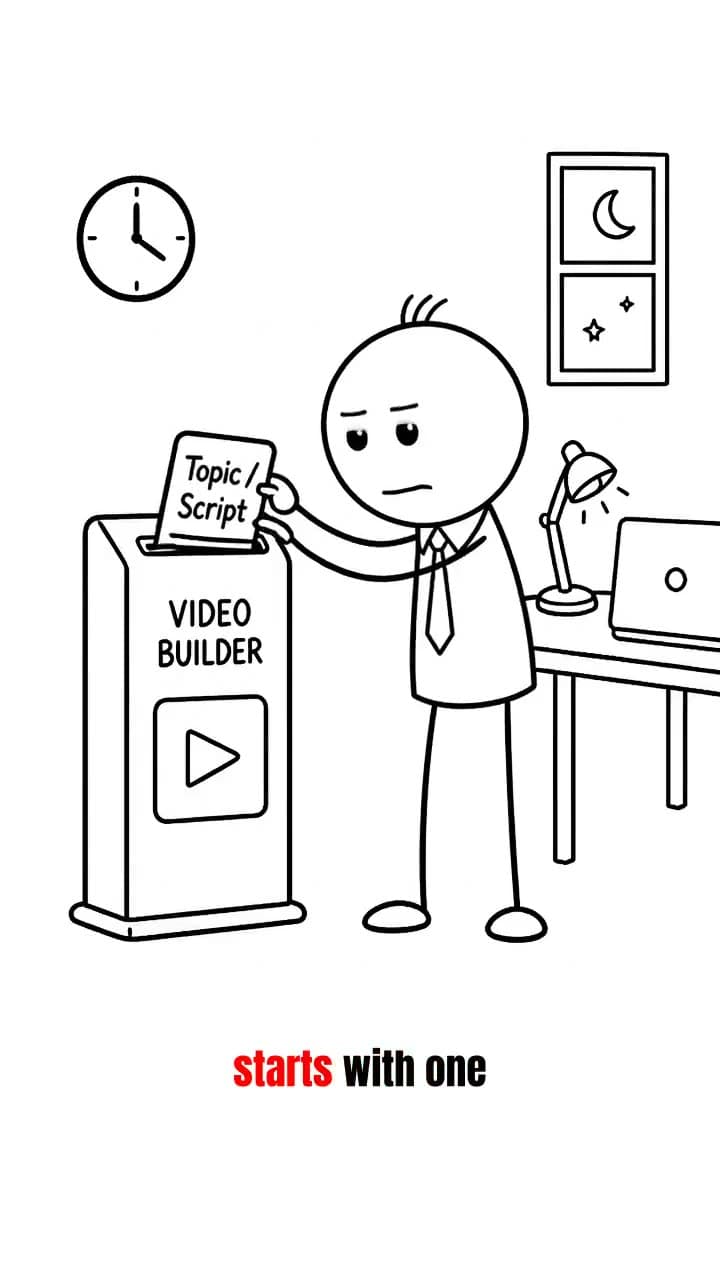
It is a real StickReel export made from one line of text. Below the video you get that prompt, the settings, every narrated line with timestamps, and the description and hashtags used to publish it.
Generated on August 19, 2026 · sound on for the AI voiceover
Short answer
Monetized YouTube Shorts pay roughly 3 to 6 cents per 1,000 views, which puts a million views at about $30 to $60. Before you are accepted into the YouTube Partner Program, 1,000 views pays nothing at all. Shorts ad money is pooled and split by eligible views, creators keep 45% of their allocated share, and the rate moves with the viewer’s country and advertiser demand.
The prompt
What was typed to get this video
Generate from topic
how much youtube shorts pay for 1 000 views
A question typed exactly as a viewer would search it. The script that comes back answers it in the first sentence and then supports it — which is the same structure that wins featured snippets, so a prompt phrased as a real query tends to produce a well-ordered video.
Settings used
- Starting point
- Generate from topic
- Script format
- Explainer
- Video style
- Mixed Motion (animation on key scenes)
- Aspect ratio
- Portrait 9:16 (720 × 1280)
- Length
- 36 seconds
- Captions
- Burned in
- Character
- Classic stickman
- Narration
- English, auto-detected from the topic
Transcript
The full script, word for word
Every line below was written by AI from the one-line prompt, then read by the AI voice and burned into the video as subtitles. Timestamps mark where each line starts.
- 0:00
One million YouTube Shorts views can pay less than you think.
- 0:03
No Partner Program or Shorts Module?
- 0:06
A thousand views earns zero.
- 0:08
Qualify with 1,000 subscribers plus 10 million valid public Shorts views in 90 days, or 4,000 valid public long-form watch hours in 12 months.
- 0:18
At 3–6 cents per thousand, a million views pays $30–$60.
- 0:22
Shorts ads are pooled; eligible views set your share.
- 0:25
Country and demand shift it.
- 0:28
You keep 45%.
- 0:30
Treat Shorts as discovery: send viewers to long videos, affiliate links, or products.
Description
The description and hashtags used to post it
A description that repeats the steps gives the platform text to match against search queries, and gives viewers a reason to stay on the page after the video loops. Swap the link for your own and it is ready to paste.
How much do YouTube Shorts pay for 1,000 views? The real numbers
One million Shorts views pays less than almost everyone expects. Here are the actual figures:
• Not in the Partner Program yet? 1,000 views earns exactly $0.
• To qualify: 1,000 subscribers + 10 million valid public Shorts views in 90 days, OR 1,000 subscribers + 4,000 valid public long-form watch hours in 12 months.
• At 3–6 cents per 1,000 views, a million views pays roughly $30–$60.
• Shorts ad money is pooled — your eligible views decide your share, and creators keep 45%.
• Your viewer’s country and advertiser demand move the rate more than anything you control.
The takeaway: treat Shorts as discovery, not income. Send viewers to long-form videos, affiliate links, or your own products.
This video was generated from a single line of text with StickReel — script, voiceover, scenes, and subtitles included: https://stickreel.com
Hashtags
- #youtubeshorts
- #shortsmonetization
- #youtubemonetization
- #creatoreconomy
- #youtubetips
- #youtubegrowth
- #shorts
- #youtubepartnerprogram
- #contentcreator
- #sidehustle
- #facelessyoutubechannel
- #stickreel
Use three to five of these per upload rather than all of them. Pick the two that describe the niche, one that describes the format, and one branded tag you reuse on every video.
The numbers
What actually decides your Shorts payout
Thirty-six seconds is enough to state the figures but not to explain where they come from. Here is each one with the mechanism behind it.
- 1
Before monetization, 1,000 views pays exactly nothing
This is the part that surprises people. Views alone do not generate income — you have to be accepted into the YouTube Partner Program and have accepted the Shorts monetization terms. Until then a video can pass a million views and pay zero. Any “Shorts money calculator” that gives you a number without asking about your monetization status is quietly assuming you are already in.
- 2
There are two doors into the Partner Program
Either 1,000 subscribers plus 10 million valid public Shorts views in the last 90 days, or 1,000 subscribers plus 4,000 valid public long-form watch hours in the last 12 months. The gap between those two numbers tells you how YouTube values the formats. Note that Shorts views do not accumulate toward the 4,000 watch hours — the two paths are counted separately.
- 3
3 to 6 cents per 1,000 views is the working range
That is the figure the video uses, and it lines up with what monetized creators typically report. It means a million views is roughly $30 to $60 rather than the several hundred dollars the same view count would earn on long-form video. Treat it as a planning range, not a promise: your own number will land somewhere around it once you have enough monetized months to average.
- 4
Shorts ad revenue is pooled, not attached to your video
This is the mechanism that makes Shorts different. Ad money from the Shorts feed goes into a pool, and your eligible views determine your share of it rather than the ads shown on your specific video. That is why one strong Short does not spike your earnings the way a strong long-form video does, and why your rate drifts month to month without anything on your channel changing.
- 5
You keep 45% of your allocated share
After music licensing costs are covered, creators receive 45% of the revenue allocated to them — a fixed split, whether you use licensed music or none at all. The 3 to 6 cent range already reflects this, so do not subtract it a second time when you estimate.
- 6
Country and advertiser demand move it more than you can
An audience in the United States, the UK, or Australia is worth several times an audience in a low-CPM market, and advertiser demand swings seasonally — December pays noticeably better than January. Both of these outweigh anything you can optimise in your editing, which is the single most useful thing to understand about Shorts revenue.
- 7
So treat Shorts as discovery, not as income
The closing line of the video is the actual takeaway. At these rates, ad revenue is a rounding error next to what the same views are worth as traffic — sent to a long-form video that monetizes properly, to an affiliate link, to an email list, or to your own product. Creators who earn well from Shorts are almost always monetizing the attention somewhere else.
Breakdown
Why this video works
The hook is a disappointment, and that is why it works
“One million YouTube Shorts views can pay less than you think” contradicts what the viewer expects to hear. Reversing an expectation is a stronger opening than promising good news, because the viewer has to keep watching to find out how bad it is.
It answers the title question with a number
The video commits to 3–6 cents per thousand and $30–$60 per million instead of hedging with “it depends”. Search traffic for a money question rewards a specific figure; the caveats come after the answer, not instead of it.
It handles the precondition before the arithmetic
Most videos on this topic quote an RPM to people who cannot earn anything yet. Putting “A thousand views earns zero” before the rate means the viewer learns which situation they are actually in, which is the difference between a useful answer and a misleading one.
The requirements are shown, not just narrated
The 1K / 10M / 4K checklist appears on a whiteboard in the frame while the narration reads it out. Numbers are the hardest thing to absorb from audio alone, so showing them on screen is where an illustrated explainer beats a talking head.
It closes with a reframe instead of a sign-off
“Treat Shorts as discovery” turns bad news into a strategy, which gives the viewer a reason to save the video. A short that ends on an instruction almost always outperforms one that ends on “thanks for watching”.
For the full walkthrough of the tool itself — formats, characters, voices, and regenerating single scenes — read how to make a stickman animation.
FAQ
Frequently asked questions
How much do YouTube Shorts pay for 1,000 views?
Roughly 3 to 6 cents per 1,000 views if your channel is monetized, so 1,000 views is a few cents rather than a few dollars. If you are not yet in the YouTube Partner Program with the Shorts terms accepted, 1,000 views pays nothing at all.
How much is 1 million Shorts views worth?
About $30 to $60 at the typical Shorts rate. The same million views on long-form video would usually earn several hundred to a few thousand dollars, because long-form ads are attached to your video while Shorts revenue is shared out of a pool.
Do you get paid for Shorts views before you are monetized?
No. Views on their own generate no income. You need to be accepted into the YouTube Partner Program and have agreed to the Shorts monetization module before any view earns anything, which is why early channels see millions of views and an empty dashboard.
How many subscribers do you need to monetize Shorts?
1,000 subscribers, plus either 10 million valid public Shorts views in the previous 90 days or 4,000 valid public long-form watch hours in the previous 12 months. There is also a lower tier at 500 subscribers that unlocks fan funding features like memberships and Super Thanks, but not ad revenue sharing.
Do Shorts views count toward the 4,000 watch hours?
No. Shorts views and long-form watch hours are counted on separate tracks, so a channel that only posts Shorts has to reach the 10 million view threshold instead. This is the detail that catches out creators who assume all their watch time pools together.
Why is the Shorts RPM so much lower than long-form?
Because of how the ads work. In long-form, ads run in and around your specific video, so the revenue is traceable to it. In the Shorts feed, ads appear between videos, so the money is pooled and divided by eligible views across all creators — and after music licensing, creators keep 45% of their allocated share.
What earns more than Shorts ad revenue?
Almost everything else: sending viewers to a long-form video that monetizes properly, affiliate links, sponsorships, an email list, or your own product. At 3 to 6 cents per thousand views, the attention a Short generates is worth far more as traffic than as ad revenue.
More examples
Other videos with prompt and transcript


Make this video with your own topic
Type one line, get a finished vertical video with script, voiceover, and subtitles. Your first one is free — see pricing or browse more examples.